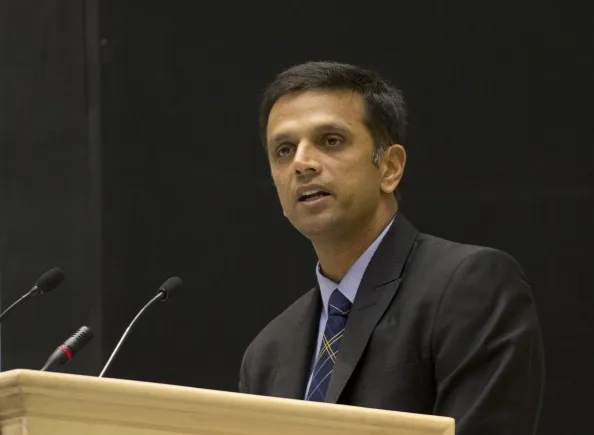
There Was Rahul Dravid
I had rushed to the cricket nets after college and finished my practice. I did my usual warm-ups, bowled for an hour and a half or so, and quickly changed back into my regular clothes. The day was special. The Coimbatore Cricket Association was holding its annual awards ceremony, and the winning teams would receive their trophies. Friends Cricket Club, the team I represented, played in the A-division and was this season’s division winner. I had played a small part in the victory, taking a hat-trick in the final division match that sealed our place at the top. It was a split hat-trick—two wickets at the end of one over, followed by one more at the start of my next.
When I arrived at the hall, it was packed to bursting. The reason? The chief guest handing out the awards was none other than Rahul Dravid. The year was 1997, and he had just returned from a successful tour of South Africa, where he cemented his reputation as “The Wall.” Against an attack led by the greats Allan Donald, Shaun Pollock, and Brian McMillan, he had shown his mettle. His first Test century, a steadfast 148 in the final Test at Johannesburg, helped India secure a draw and was one for the ages.
As the ceremony began, I hoped to join the team photograph when our captain collected the winner’s trophy. But when our team’s name was announced, a surge of players rushed to the dais. Our club fielded three teams in the league, with the other two in the lower divisions, but all shared the same name: Friends Cricket Club. Players from the other two teams, along with a few from mine, surged forward, eager to be close to the great man. They jostled and nudged, while Dravid smiled through it all. There wasn’t an inch of space left on the dais, and I simply didn’t have it in me to push, jostle, or elbow my way in—not then, and not now.
I sat down, realizing I had plenty of space around me; most of them were on the dais anyway. I slowly soaked it all in.
Here was one of India’s finest, smiling and handing over the trophy to our captain, then making a speech that exemplified his intellect and insight. Dignity, class, and humility—the qualities that would define him later—were evident even then. I knew then and there that he would make India proud. His epics—the 180 in Kolkata, the 233 in Adelaide, and many others—would prove me right. Years later, I heard the great Matthew Hayden describe Dravid: “He played not just by the rules of cricket, but the rules of life.”
How true.
When I moved my company to a new office years later, I dedicated a wall to framed pictures of sportsmen and women I admired. There was Malcolm Marshall, Curtly Ambrose, Paavo Nurmi, Nadia Comaneci, Muhammad Ali—and Rahul Dravid. The photo was of a smiling Dravid shaking hands with a beaming Graeme Swann, the English spinner, after scoring yet another century. It was his last series, in England, and he bowed out with three centuries from five Tests.
Sometimes I stand by that wall and look at these great men and women. And when my eyes fall on Dravid’s picture, I realize, with a smile, that I’m closer to him there than I ever was all those years ago.